

SKU:CM
Colour Match: First Colours Card Game for Toddlers
Couldn't load pickup availability
A first colour game for toddlers: 30 cards in 6 colours to sort, match and name
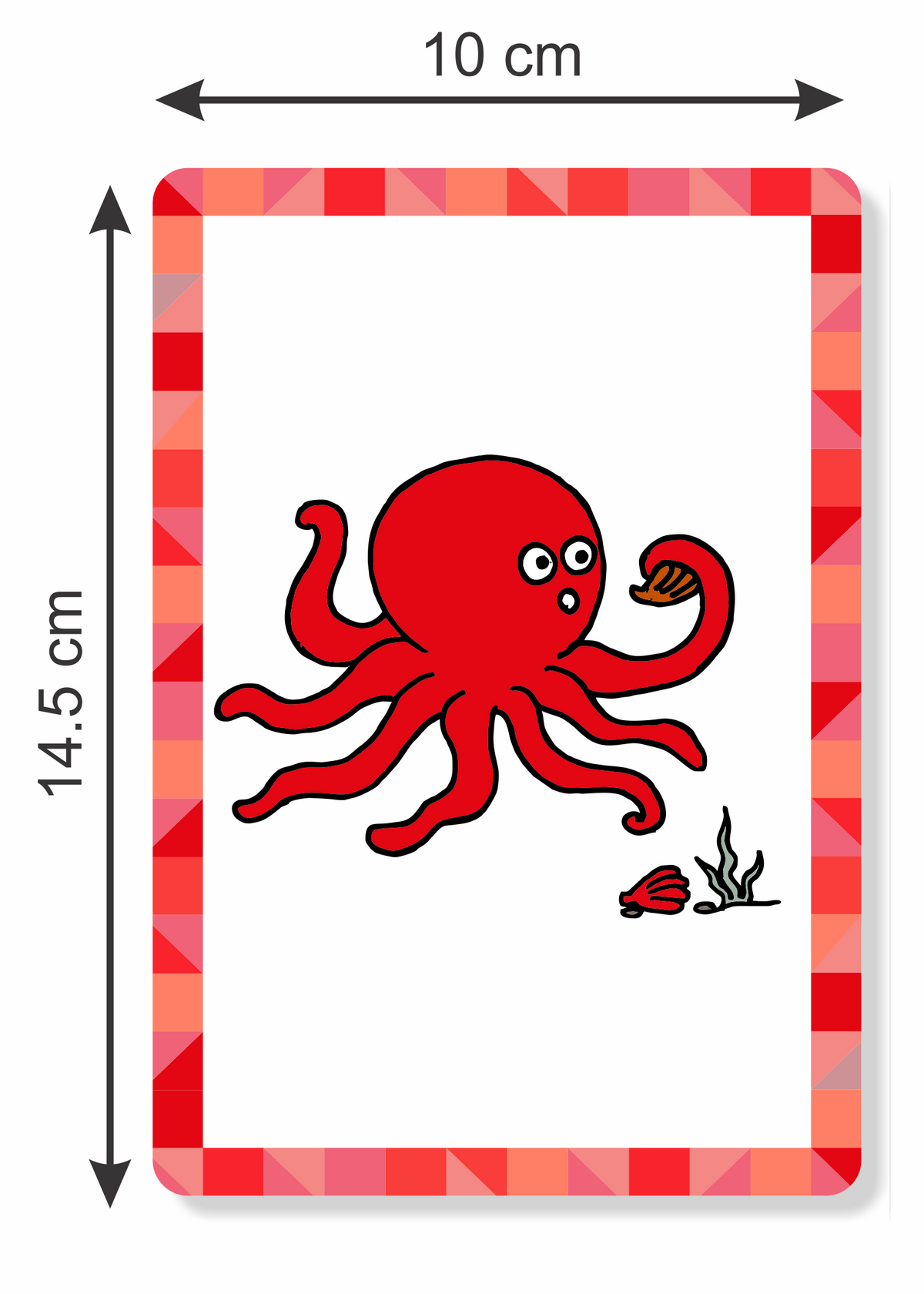
Colour Match teaches toddlers their first colour words through simple grouping games. Each card shows a friendly creature, such as a crab, an octopus or a dinosaur, with a matching coloured border. The same creatures appear in different colours, so children can sort the cards by colour or by creature, and start to understand that "red" or "green" describes something, whatever it is.
At a glance
- 30 jumbo cards, 14.5 × 10 cm
- 6 colours (green, red, yellow, purple, orange and blue), 5 cards each
- Each card: one creature with a border in the same colour
- The same creatures appear in different colours, for sorting two ways
- Blank backs
- Rules left flexible, so very young children can play their way
- Builds colour words, attention, matching and turn-taking
- Sturdy glossy laminated card with rounded corners
- Ages 2+
- Designed by speech and language professionals
Why sorting helps children learn colours
Children often learn to say colour words before they understand them. Sorting the same creature into different colours, and different creatures into the same colour, shows them that colour is a property that can change while the thing stays the same. That idea is the starting point for all describing words.
Ways to play
- Sort by colour: make a pile for each colour. "Where does the red octopus go?"
- Sort by creature: put all the octopuses together, then name each one's colour.
- Find the match: hold up a card and ask your child to find another of the same colour.
- Take turns: each player picks a card, says its colour and adds it to the right pile.
- Give me…: lay out a few cards and ask your child to give you "the green one".
Start with two colours and add more as your child gets confident.
Who it's for
- Toddlers learning their first colour words
- Children who can say some colours but mix them up
- Children with speech or language delays, including children with autism
- Children learning English as an additional language
- Parents, preschool teachers and speech and language therapists
Where it fits
- Use alongside: Which? Verbal Reasoning Part 2, describing objects by how they look and feel, including colour
- Use alongside: Super Talker, functional language games, including a colour game, for ages 4+
- Next: Everyday Objects Level 1, first words for everyday things
Who made it
Brainy Bug Resources decks are designed by speech and language professionals with extensive clinical experience in mainstream schools, special schools and community clinics. Each deck follows how children's language actually develops, from single words to two-word phrases, sentences and reasoning.
Frequently asked questions
What age is it for?
2 years and up.
Which colours are included?
Green, red, yellow, purple, orange and blue.
Are there rules?
The game is kept simple and flexible, so you can adapt it to your child. Grouping by colour is the main activity.
What's on the back of the cards?
Nothing. The backs are blank.
Does it have audio?
No. It's designed for an adult and child to play together.


- Who We Are
- What Makes Us Unique
Brainy Bug Resources is built by speech and language therapists with extensive clinical experience in mainstream schools, special schools and community clinics. Because language lies at the heart of all learning, our range goes beyond first words, covering vocabulary, grammar, reasoning, emotions, storytelling, phonics and more. Every resource follows the order in which children's language develops.
- Built in developmental order. Each deck has a clear place in a child's language journey, so you always know the next step.
- Audio in up to 9 languages. Hear every word and sentence through the Chatterbugs app, slow it down, or record your own voice as the model.
- Designed to get children talking. Picture-only sides, a monkey character and contrast sets give children a reason to find the words themselves rather than copy them.
- Space for your home language. Writing lines on the back let parents add words in the language they speak at home.
- Made for home, classroom and therapy. The same cards work for a parent at the dinner table and a therapist in a session.